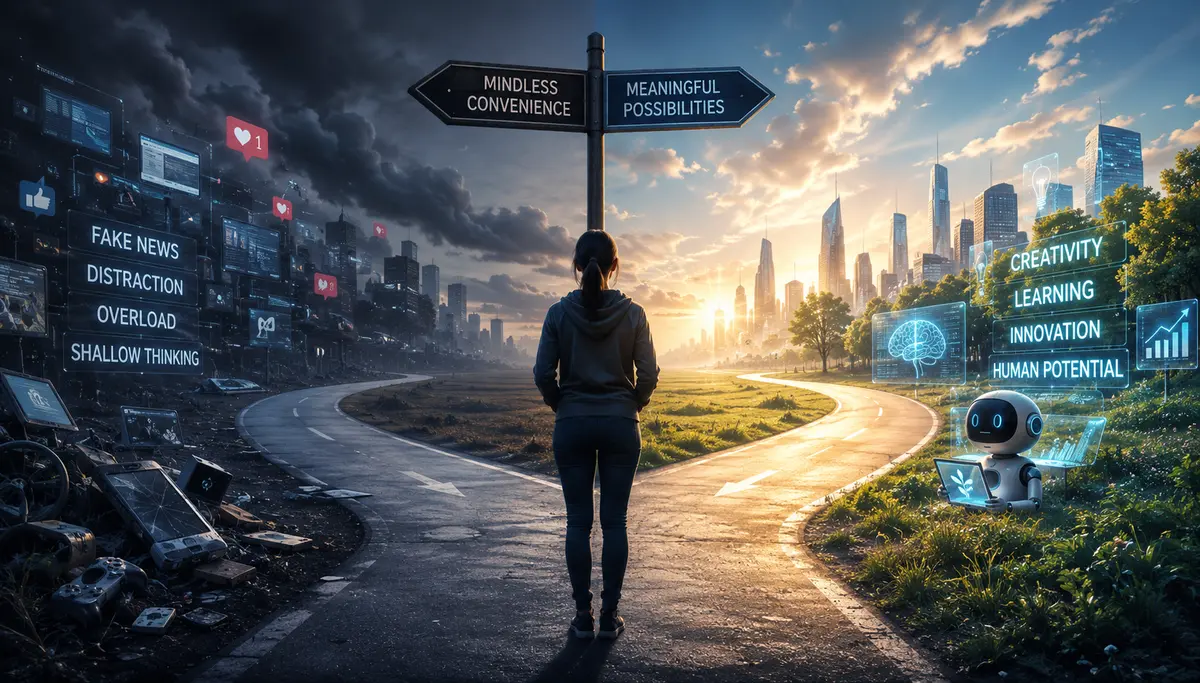
Every generation fears the next big technological shift.
The printing press.
Electricity.
Cars.
The internet.
Smartphones.
Every one of them sparked warnings that we'd lose important skills, become too dependent on technology, or somehow make society worse.
Today, those conversations are about AI.
I hear it all the time.
"People won't know how to spell."
"People won't know how to think."
"People won't know how to solve problems."
Those concerns deserve discussion—but history also offers perspective.
Technology has rarely replaced human capability. More often, it has changed where we choose to apply it.
When calculators became common, many worried we'd stop learning mathematics. Instead, calculators freed us from repetitive calculations so we could tackle more advanced problems.
The tool changed. The thinking evolved.
That's what technology has always done.
What Technology Gives Back
Every meaningful innovation gives us something valuable:
Time.
The question isn't whether we save time. The question is what we choose to do with it.
AI is no different.
At TechTidy, I don't see AI as a replacement for people. I see it as a tool that helps people learn faster, organize ideas more clearly, reduce unnecessary friction, and spend more energy on meaningful work.
That matters because people don't all learn the same way.
Someone with dyslexia may have brilliant ideas but struggle to organize them on paper. Voice tools, summarization, and structured prompting can help bridge that gap—not by replacing intelligence, but by removing barriers that make it harder to express.
The intelligence was always there. The technology simply helped unlock it.
I've experienced something similar myself.
Building TechTidy has reinforced that for me. AI didn't create the ideas —it helped me organize them, test them, and bring them to life faster.
It helps me organize complex ideas, connect concepts, structure learning experiences, and build projects more efficiently.
Not because it thinks for me— because it helps me think more clearly.
AI should never replace critical thinking.
It should strengthen it.
I don't believe technology exists to remove every challenge.
I believe it should remove unnecessary friction so we can spend more time solving better problems.
Creating. Learning. Questioning. Innovating.
That's progress.
The Real Risk
The danger isn't AI.
The danger is choosing convenience over curiosity.
Speed over understanding.
Validation over truth.
Every technology has the potential to make us more capable—or more passive.
AI is no different.
The outcome depends less on the technology than on the habits we build around it.
That choice still belongs to us.
Technology should help people become more capable—
not more dependent.
That's the future I want to help build.
About the Author
Rachel Ryan is a Technical Analyst, trainer, and creator of TechTidy. She develops plain-language learning experiences that help people understand technology, make informed choices, and build practical digital confidence. Her work focuses on technical enablement, responsible AI education, and inclusive learning design.