Every generation fears the next big technological shift.
The printing press.
Electricity.
Cars.
The internet.
Smartphones.
Each one came with warnings that society would fall apart, people would lose essential skills, and the world would somehow get worse.
Now it’s AI.
I hear it all the time.
“People won’t know how to spell.”
“People won’t know how to count.”
“People won’t know how to think.”
Maybe.
But history tells us something different.
When calculators came along, people warned we’d lose basic math skills. Yet the opposite happened. We didn’t become worse at math. We became capable of more advanced math because we were freed from manual drudgery.
The tool changed. The thinking evolved.
That’s what technology has always done.
Before electricity, we lit lanterns.
Before the internet, information was harder to access.
Before smartphones, we had to remember everything or carry it on paper.
Every major advancement has given us something valuable back.
Time.
And with every shift, there’s a choice. We can use that time to grow, or we can waste it.
AI is no different.
At TechTidy, I don’t see AI as a replacement for people. I see it as a tool that can help people work smarter, learn faster, and unlock potential that often gets buried under outdated systems.
That matters because not everyone learns the same way.
Some people struggled in classrooms not because they weren’t intelligent, but because the system wasn’t built for how they process information.
Take someone with dyslexia. They may have brilliant ideas but struggle to get them onto paper. With AI, voice-to-text and idea structuring can help them organize those thoughts clearly and faster.
The intelligence was always there. The barrier was the method.
I’ve experienced this myself.
AI has doubled my productivity. It helps me organize complex ideas, build systems, and create faster than I could before. Not because it’s doing the thinking for me, but because it’s helping me think more clearly.
That distinction matters.
AI should not replace critical thinking.
It should sharpen it.
I don’t believe humans are meant to avoid challenge. We need challenge. We need growth. We need resistance.
But maybe the purpose of technology isn’t to remove struggle altogether.
Maybe it’s to remove the unnecessary struggle so we can take on better ones.
Harder creative work.
Bigger problems.
Deeper questions.
New scientific frontiers.
That is the kind of struggle that moves humanity forward.
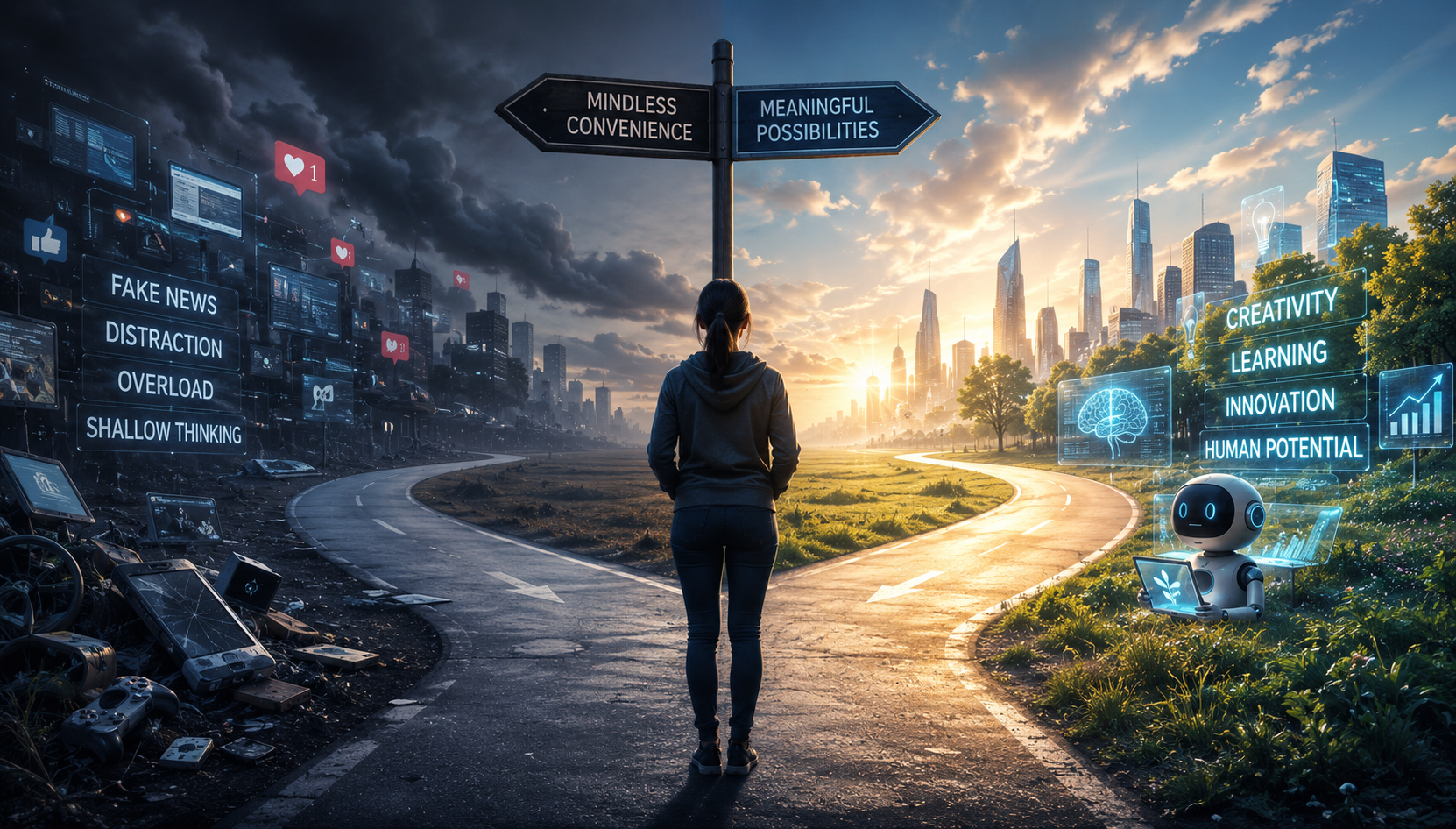
The danger isn’t AI.
The danger is choosing convenience over curiosity.
Speed over understanding.
Validation over truth.
AI can either sharpen us or soften us.
That choice still belongs to us.
It always has.