What You’ll Learn
- Why AI can produce plausible but incorrect information
- What an AI hallucination is
- When verification matters most
- How bias and missing context can affect an answer
Can You Trust AI?
People often ask,
Can I trust AI?
The better question is:
When should I trust AI?
Artificial intelligence is incredibly useful, but it isn't an expert that always knows the correct answer. Like any tool, it has strengths, limitations, and situations where human judgment is still essential.
AI Doesn't Know Facts
One of the biggest misconceptions about AI is that it has a giant database of correct answers stored somewhere.
It doesn't.
Modern AI generates responses by predicting the words that are most likely to come next based on patterns it learned during training.
Most of the time, those predictions are remarkably useful. Sometimes they aren't.
Remember This
AI predicts language. It doesn't verify truth.
What Is an AI Hallucination?
A hallucination happens when AI creates information that isn't true but presents it confidently as if it were.
For example, AI might:
- Invent a book that doesn't exist.
- Create fake website links.
- Misquote a research paper.
- Make up legal cases.
- Invent company policies.
- State incorrect facts with complete confidence.
These mistakes usually aren't intentional. The AI is generating what appears to be a plausible answer rather than checking whether it's actually correct.
A Human Example
Imagine asking someone for directions.
They don't actually know where the restaurant is, but instead of saying,
"I'm not sure."
they confidently point three blocks in the wrong direction.
They weren't trying to mislead you. They simply believed their answer sounded right.
AI can behave in a similar way.
Confidence Isn't Accuracy
One of the easiest mistakes to make is assuming that a confident answer must also be a correct answer.
In reality, those are two different things.
Good AI users separate:
- How confident something sounds
- How likely it is to be true
This habit alone will help you use AI much more responsibly.
When Should You Verify?
Not every AI response needs to be fact-checked.
If you're asking AI to:
- brainstorm ideas
- rewrite an email
- summarize your own notes
- generate a shopping list
- suggest recipes
verification usually isn't critical.
However, you should always verify information related to:
- medical advice
- legal matters
- financial decisions
- taxes
- contracts
- academic research
- statistics
- quotations
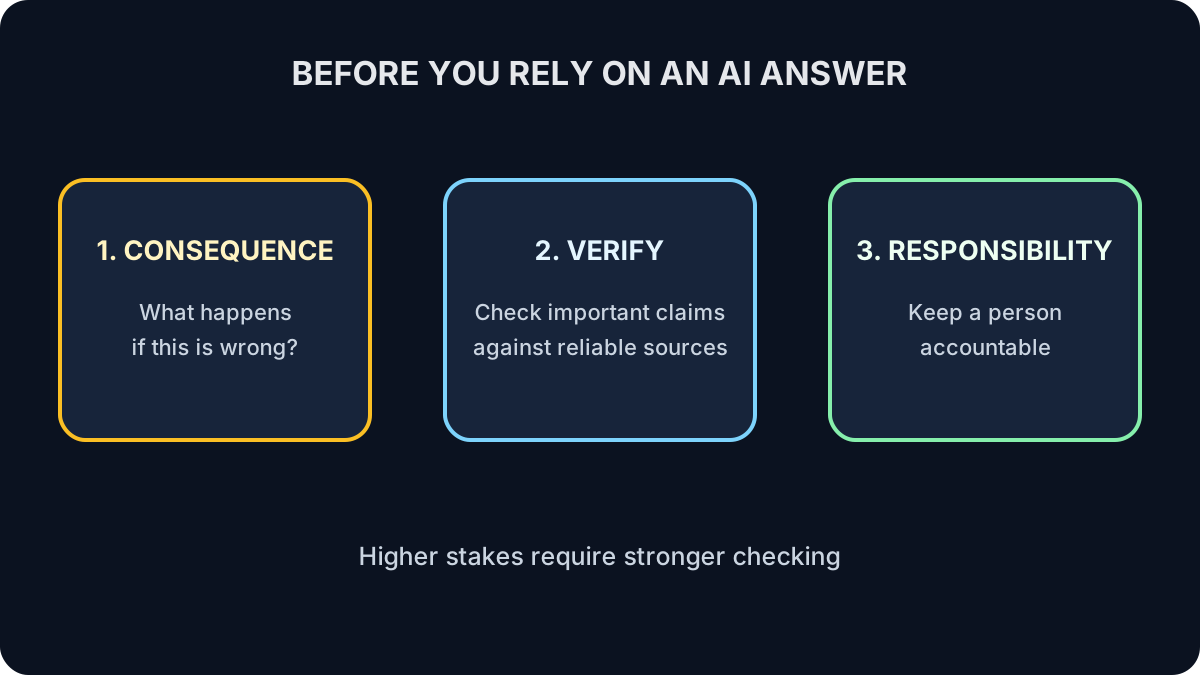
Whenever the consequences of being wrong are significant, always confirm the information using trusted sources.
AI Can Reflect Bias
AI learns from information created by people.
Because of that, it can sometimes reflect:
- historical bias
- cultural assumptions
- stereotypes
- outdated information
This doesn't necessarily mean the AI is intentionally biased. It often reflects the strengths and weaknesses of the information it learned from.
Understanding this helps you evaluate responses more thoughtfully.
Try It: Plan a Verification
Imagine an AI gives you this answer about a fictional town:
“Pine Harbour Library lends tools from every branch and never charges late fees.”
Before repeating the claim, identify what needs checking:
Which branches lend tools? Are there eligibility rules? Is the no-fee policy current?
Decide which source should be authoritative.
Because Pine Harbour is fictional, no real source can confirm the claim. In a real situation, check the library’s official website or contact the library directly—not a second AI-generated answer.
This simple exercise demonstrates an important principle:
Using AI responsibly means learning to verify important information—not simply accepting every answer at face value.
Think of AI Like GPS
Most people trust their GPS.
It usually gets them where they want to go.
But sometimes:
- roads are closed
- maps are outdated
- construction changes the route
You wouldn't throw away your GPS because it occasionally makes mistakes.
But you also wouldn't drive into a lake just because it suggested the route.
AI works much the same way.
The Goal
Use AI as a powerful guide—not as an unquestionable authority.
Quick Knowledge Check
1. What is an AI hallucination?
Answer
An invented or incorrect output presented as though it were reliable.
2. Does a confident tone prove accuracy?
Answer
No. Tone and factual accuracy are separate.
3. When should verification be strongest?
Answer
When an error could affect health, rights, money, safety, employment or another important decision.
What to Remember
Remember This
The goal isn't to trust AI.
The goal is to understand when AI deserves your confidence—and when your own judgment should take over.
The most effective AI users combine curiosity, critical thinking, and verification.
AI helps you work faster. Your judgment helps you work smarter.
Next: Choosing the Right AI Tool
Accuracy is only one part of responsible use. Next, consider privacy, information sensitivity, approval and accountability.
Continue to Lesson 4 →